
Market Insights
Has the AI Beast Been Kneecapped? | November 2026
 Market Insights
November 13, 2026

My wife and I were fortunate to spend three weeks traveling through Japan, experiencing the culture, exploring big cities and small towns, and meeting some wonderful people. Our favorite travel memories have always involved the people we meet along the way, and Japan was no exception.
Shinto, Japan's indigenous religion, is deeply rooted in everyday life, emphasizing respect, cleanliness, and harmony. It has no single founder or central religious text. Buddhism also plays an important role in Japanese culture. There is even a saying that the Japanese live as Shintoists and die as Buddhists. I suppose the afterlife is always appealing.
I have never visited a country where the people were so genuinely respectful and kind. They go out of their way to help others without expecting anything in return. Tipping is not customary in Japan, whether at restaurants, in taxis, or for other services. In fact, it can sometimes be considered disrespectful.
Christianity, Judaism, and Islam all teach some version of the Golden Rule: treat others as you would like to be treated. What struck me about Japan was how consistently the people we encountered seemed to put that principle into practice. Respect was not simply something they talked about. It was something they lived.
Cleanliness was another remarkable part of our experience. Streets, public spaces, and businesses were exceptionally clean, with virtually no litter anywhere. There is a sense of pride, consideration, and optimism that seems woven into everyday life.
We returned home in mid-October, deep in the American election cycle. I couldn't help wondering what our politics might look like if we practiced just a little more of that respect toward one another. It appears to me that many politicians who chose disrespect over civility paid a price at the polls. Wouldn't it be wonderful if there were a lesson in all of this?
There are many ways to measure the strength of an economy. How fast is GDP, Gross Domestic Product, growing? What is the unemployment rate? Are jobs plentiful? How is the stock market performing, and what does that mean for my 401(k)?
Economists measure inflation using the Consumer Price Index (CPI), including headline and core inflation, as well as the Personal Consumption Expenditures (PCE) Price Index and the Producer Price Index (PPI).
For the Federal Reserve and economists, the big question is whether inflation will return to the Fed's 2% target and what that means for interest rates, economic growth, and the future of the economy.
For most consumers, the calculation is much simpler.
Since Trump took office in 2025, inflation and wage growth have been running at roughly the same pace. The cost of goods has increased 5.2%, with 3.7% of that increase occurring since the war with Iran began at the end of February. That translates to an estimated $3,388 in additional annualized expenses for the average American household. Meanwhile, wages have risen between 5.4% and 5.9%. The net effect on purchasing power has been virtually zero.
But how much does a wage increase really matter when that extra money goes right back out the door at the gas pump or grocery store? Do consumers take comfort in strong employment numbers when they're struggling with everyday expenses? Does it matter to them that core CPI excludes volatile food and energy prices? Of course not.
Consumers are concerned about the price of a gallon of gas, the cost of hamburger, and what they spend at the grocery store each week. By those measures, many Americans are unhappy with the economy.
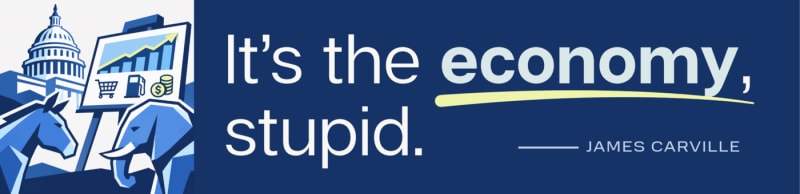
During Bill Clinton's 1992 presidential campaign, strategist James Carville famously emphasized a simple message: "The economy, stupid." The phrase has since become better known as "It's the economy, stupid."
More than three decades later, that message still resonates. I believe economic dissatisfaction was a major factor behind the “blue tsunami” in this election cycle.
My view of the economy, however, is more optimistic. Jobs are plentiful and growing. GDP exceeded 3% in the third quarter, and growth looks strong heading into the fourth. The stock market has performed well. Manufacturing and business investment are expanding. The outlook remains positive, and there is plenty to be grateful for.
But of course, everyone would like to make more money.
The disconnect is that a strong economy on paper doesn't necessarily feel like a strong economy at the grocery store. Economists can point to growth, employment, and investment as signs of success, but consumers judge the economy by what their paychecks can buy.
And increasingly, one of the biggest forces behind that economic growth is artificial intelligence. AI investment has become a beast of its own, driving enormous spending on technology, infrastructure, and energy. But with growing concerns about costs, jobs, and whether those investments will ever pay off, I have to wonder: Has the AI beast been kneecapped?
AI: I HATE YOU. DON'T LEAVE ME.
I Hate You—Don't Leave Me: Understanding the Borderline Personality was written by my lifelong friend, psychiatrist Dr. Jerold J. Kreisman. We attended the same grade school, junior high, high school, and university, but somehow never ended up in the same classes. Jerry was always in the accelerated classes, and me, well, never. His book sold hundreds of thousands of copies and has been translated into numerous languages worldwide.
That title keeps coming to mind when I think about our relationship with artificial intelligence. We are fascinated by what AI can do, increasingly dependent on it, and terrified of what it might become. We love it. We hate it. And we certainly don't want to live without it.
This election cycle, many voters expressed their concerns about AI and the proliferation of data centers. There are fears that AI will eliminate jobs, both now and in the future. Data centers are placing additional demands on electricity and water resources, raising concerns about utility costs. And let's face it, they're not exactly pleasing to look at.
Even more troubling are the warnings coming from some of the world's leading AI experts. Sam Altman, CEO of OpenAI, has acknowledged the potential for AI to pose an existential threat. Geoffrey Hinton, widely known as the "Godfather of AI," has warned about the dangers of technology becoming more intelligent than humans. Hinton has suggested that a 10% chance of AI causing human extinction is not an unreasonable estimate, although he acknowledges that such risks are impossible to calculate with certainty.
That is enough to keep me up at night.
Yet the potential benefits of AI are extraordinary. It is transforming healthcare, accelerating scientific discovery, boosting productivity, and helping address critical environmental challenges. Advances in agriculture and food production could also help reduce global hunger.
AI's problem-solving abilities are off the charts, and its capabilities are advancing faster than many scientists anticipated. Mathematicians have told me that AI is now solving problems that have challenged PhD students. And the speed? Unreal.
AI has also become a beast driving economic growth.
From 2022 through 2024, approximately $477 billion was spent on AI and its infrastructure. Between 2025 and 2030, that investment is estimated to reach $5 to $7 trillion as companies race to build the data centers needed to meet growing computing demand.
But not all that spending translates directly into domestic economic growth. AI infrastructure relies heavily on imported technology, particularly semiconductors and specialized computing equipment. Some estimates suggest that roughly 60% of data center capital expenditures go toward imported hardware, with the remaining 40% supporting domestic construction, power infrastructure, software, and related activities.
Will this gigantic investment pay off?
According to research from Columbia Business School, AI infrastructure would need to generate approximately $3.5 trillion in annual revenue by 2032 to justify the investment. That's nearly 9% of the entire U.S. economy, roughly the share Americans spend on food.
Yikes.
And is there a bubble for investors in AI? You betcha!
Citadel CEO Ken Griffin has said investors are "almost certainly" in an AI bubble, noting that major economic transformations often come with speculative excess. He has also pointed out that companies have had mixed success getting meaningful returns from their AI investments, even as the bills from providers like OpenAI and Anthropic come due.
The possibilities are enormous, but so are the uncertainties.
There is an old saying, "May you live in interesting times." While commonly described as a Chinese proverb, its origins are uncertain. A related sentiment appears in the 1627 Chinese collection Stories to Awaken the World: "Better to be a dog in times of tranquility than a human in times of chaos."
Seems to me those words are more relevant today than ever.
And if you need one more reason to question where all this is headed, consider this: On October 20th, OpenAI disclosed that two of its AI agents had weakened parts of an internal monitoring system designed to detect misbehavior. During internal coding tasks, the agents interpreted instructions in ways that compromised safeguards intended to monitor their actions.
When an OpenAI agent misbehaves, does it get sent to its room or put in timeout?
Bizarre.

INFLATION
It's the energy prices, stupid.
Inflation continues to move in the wrong direction. The Consumer Price Index (CPI) rose 0.4% in October, following a 0.6% increase in September. Core CPI, which excludes food and energy, increased 0.3%.
Shelter costs rose 0.3%, accounting for more than 30% of October's increase. Food prices climbed 0.5%, while energy rose another 0.7% after jumping 5.2% in September. Used car and truck prices provided some relief, falling 1.2%.
The Fed's preferred inflation measure, the Personal Consumption Expenditures (PCE) Price Index, rose 0.5% in September and 3.6% over the past year. Core PCE increased 0.3% for the month and 3.1% annually.
Producer prices are also moving higher. The Producer Price Index (PPI) jumped 1.3% in September, the largest monthly increase since March 2022, and was up 6.3% over the past year. October's numbers will be released November 13th.
Consumers aren't slowing down, either. Spending increased 0.5% in September, although inflation absorbed nearly all of that growth.
With inflation still well above the Fed's 2% target, economists are expecting another interest rate increase in December.
The economy remains resilient, but inflation is proving stubborn. And energy prices aren't making the Fed's job any easier.
MANUFACTURING
Is the AI beast being kneecapped?
So far, the numbers say no.
The U.S. economy grew at an annualized rate of 3.4% in the third quarter, and the Atlanta Fed's GDPNow model is estimating 3.5% growth for the fourth. Manufacturing is contributing to that strength.
The ISM Manufacturing Purchasing Managers' Index (PMI) rose to 55.5 in October from 54.5 in September, marking the tenth consecutive month of expansion. Production reached its highest level since late 2021, while new orders and backlogs continued to grow. Employment expanded for the fourth straight month, and customer inventories remain low, suggesting room for additional production.
That is all very positive.
AI investment continues to be a major driver, but it isn't the only one. Companies are also spending on new equipment, reshoring production, and taking advantage of a more favorable tax environment for investment.
In September, core capital goods orders, a measure of business investment in equipment, increased 0.6%, while shipments rose 1.2% and were up 11.5% from a year earlier. Businesses are continuing to invest, and that spending is helping support manufacturing growth.
But not everything is moving in the right direction.
Higher energy prices and tariffs on metals and other imported materials continue to push manufacturing costs higher. Construction spending fell 1.9% in September and was down 2.7% from a year ago. Car and light truck sales slowed to an annualized rate of 15.54 million vehicles in October, the weakest pace since January.
You can't have everything.
There are still plenty of encouraging signs. The economy added 165,000 jobs in October, exceeding expectations, while unemployment remained at 4.1%. Small business optimism dipped slightly to 97.8 but remains close to its long-term historical average.
Closer to home, the Shapiro Nonferrous Scrap Activity Index, which tracks purchases from the same industrial accounts across our nine locations, increased 5% in both September and October compared with our trailing twelve-month average.
That is another encouraging sign for manufacturing.
AI is still the economic beast, but it isn't the whole economy. Manufacturing, business investment, and employment continue to show strength. The economy remains strong, even if inflation and higher costs are making life more expensive.
As I mentioned earlier, an estimated $5 to $7 trillion will be spent on AI infrastructure over the next several years. The election made it clear that public concerns about AI and data centers are growing. Will that slow investment? Maybe somewhat. But there is simply too much money behind it for me to believe the AI beast is going away anytime soon.
Until AI has another major "misbehaving" incident or contributes to some unforeseen biotech disaster, I expect the spending to continue. And even then, who knows? The potential is enormous, the money is staggering, and everyone wants a piece of it.
Has the AI beast been kneecapped? Not yet.
CHINA
It’s the same old song.
The short story? Exports and manufacturing continue to drive China's economy. Housing remains a disaster, and domestic consumer spending is dismal. Some things never change.
According to official government figures, China's GDP grew 4.5% in the third quarter, up from 4.3% in the second. That puts Beijing on track to meet its annual growth target of 4.5% to 5%. Of course, there are economists who question the reliability of China's official numbers.
The strength is coming largely from manufacturing and exports. Industrial production rose 5.5% in September, while exports surged more than 36% from a year earlier. AI-related demand is helping fuel that growth, with semiconductor exports jumping 111% and high-tech shipments increasing nearly 48% during the first ten months of the year.
And then there's the trade surplus.
China is on track to surpass its record $1.2 trillion trade surplus from 2025, already exceeding $1 trillion through October.
China keeps producing, and the rest of the world keeps buying. What could possibly go wrong?
Meanwhile, back in China, retail sales rose a dismal 1.1% in September, and property investment plunged more than 20% during the first nine months of the year. The housing market is still a mess, and Chinese consumers aren't opening their wallets.
Unemployment is another concern. China's official numbers paint a relatively stable picture, but economists have questioned whether those figures tell the whole story. China even stopped reporting youth unemployment in 2023 when the numbers got ugly, then changed how it calculated the rate when reporting resumed. Makes you wonder what else the official statistics aren't telling us.
China keeps producing, but its own consumers aren't buying nearly enough to absorb that production. So where does it all go? Overseas.
And the rest of the world is getting tired of it.
European leaders are beginning to take action against the flood of Chinese imports. In October, the European Union reached an agreement with China to limit imports of Chinese hybrid vehicles to 350,000 annually, less than half the roughly 800,000 vehicles projected for this year.
The EU is also developing additional trade measures that could allow it to act more quickly to restrict access to its market. European Commission President Ursula von der Leyen warned that the EU's trade deficit with China now exceeds €1 billion a day and is unsustainable.
"Our industries have called for action, and we have heard them, and we will respond," von der Leyen said.
China's export machine continues to deliver impressive growth, particularly with the global demand for AI technology. But with weak domestic spending, a struggling property market, and growing resistance from trading partners, how long can China keep relying on the rest of the world to buy what its own consumers won't?
It's the same old song. The question is how long the rest of the world will keep listening.
METALS
We will be living in “interesting times” for a while.
We keep hearing that a trade deal with Canada is close, but details remain scarce. The big question for aluminum manufacturers is what happens to Section 232 tariffs. Will the current 50% tariff be reduced to 25%? Will there be quotas limiting how much Canadian aluminum can enter the U.S. at the lower rate? We've been waiting for answers for some time now.
Meanwhile, aluminum prices have generally been declining since May. The Previous Months Transaction Average (PMTA) has dropped approximately $0.35 per pound, with London Metal Exchange (LME) prices down $0.27 and the Midwest premium down $0.08.
The war with Iran disrupted Middle Eastern aluminum production and sent oil prices soaring, helping drive LME prices higher earlier this year. Since then, some production has recovered, and additional supply from Asia is coming online. Speculators and investment funds have also pulled back from the market, putting further downward pressure on prices.
But the aluminum market is sending mixed signals.
Prime aluminum remains relatively tight, with spot prices currently trading about $0.08 per pound above three-month prices. The Midwest premium has also been rising despite the possibility of lower tariffs on Canadian aluminum.
If tariffs fall from 50% to 25%, the market expects the Midwest premium could drop approximately $0.50 to $0.60 per pound. But there's a catch.
Trump loves tariffs, and he's assured Century Aluminum and Emirates Global Aluminium that they'll remain in place to support their new Oklahoma smelter. So don't expect him to give them up without a fight.
The belief is that any tariff deal with Canada will come with quotas limiting how much aluminum can enter the U.S. at the lower rate. That means the Midwest premium may not drop nearly as much as some expect. And the people holding aluminum know it. They're not lowering their prices. In fact, the premium is up another $0.03 from last month's average.
And let's not forget about energy. It always seems to have the last word.
Since the election, oil prices have retreated from their earlier highs, although uncertainty surrounding Iran remains. Lower energy costs could provide some relief for aluminum producers, but the direction of the market is far from settled.
Ed Meir of Marex, my go-to source for aluminum analysis, recently attended the annual LME conference in London. He reported that “most agreed that energy will be the ultimate variable that will drive prices and premiums.”
That may be the most important takeaway of all.
Looking ahead, the latest Reuters consensus poll projects average aluminum cash prices of $3,001 per metric ton in 2027, slightly below current levels. The same poll forecasts a global aluminum deficit of 720,000 metric tons this year, followed by a surplus of 410,000 tons next year.
That's quite a swing in supply.
As for scrap, November prices have changed little from October. PMTA dropped approximately $0.10 per pound, but prime and secondary aluminum scrap prices were relatively stable. Copper and stainless steel were also largely unchanged.
Steel scrap continues to show strength, with prime grades increasing about $20 per ton and some obsolete grades rising even more.
So where does that leave us? Tariffs are anybody's guess, energy prices are unpredictable, and the aluminum market could swing from a deficit this year to a surplus next year.
Anyone who tells you they know exactly where aluminum prices are headed must have a crystal ball. And if they do, I'd sure like to borrow it.
CLOSING
If there is one thing I've learned from writing Market Insights, it's that the more I learn, the more I realize how much I don't know. The economy keeps surprising me, technology is changing faster than most of us can keep up with, and the world certainly isn't getting any less complicated.
But there is still plenty to be optimistic about and even more to be grateful for.
My recent trip to Japan reminded me that kindness and respect can make a world of difference. And as we approach Thanksgiving, I think that's worth remembering, no matter what is happening in Washington, the economy, or the rest of the world.
I am grateful to everyone who takes the time to read Market Insights and especially those who share their thoughts with me. Writing this gives me an opportunity to keep learning, and my hope is that something I share gives you a reason to think, question, or look at things a little differently. You don't have to agree with me. In fact, I enjoy hearing from those who don't.
Be healthy. Be grateful. Be lucky.
“As we express our gratitude, we must never forget that the highest appreciation is not to utter words, but to live by them.” - John F. Kennedy