
Case Studies
1,000,000 Pounds Diverted from Landfill
 Case Studies
February 9, 2026
Maximized Material Recovery from Obsolete Subsea Umbilical Cable
How Shapiro diverted five miles of obsolete subsea umbilical cable from landfill — recovering copper, steel, stainless steel, polyethylene, and carbon fiber at industrial scale.
The Industry Problem
The offshore energy industry faces a $103 billion decommissioning wave over the next decade. Subsea umbilicals — the cables that deliver power, hydraulic control, and chemical injection to underwater production systems — are a significant piece of that waste stream.
Nearly two-thirds of all subsea cable ever installed is now out of service. And the industry’s reported recycling rates don’t tell the full story.
Major operators report 97–98% recycling. Independent research puts the real number below 65%.
That gap exists because headline figures count only steel from platform topsides. Cables, polymers, and composites are often excluded from the math. In 2024, ExxonMobil’s own sustainability reporting showed just 17% landfill diversion on significant decommissioning projects.
The regulatory pressure is tightening. The EU Environmental Crime Directive (expanded March 2024) now imposes penalties up to 5% of total worldwide turnover. In the US, BSEE requires complete removal of subsea infrastructure within one year of lease termination. A 2023 GAO audit found 2,700 wells and 500 platforms overdue for decommissioning — with federal bonds covering just $3.5 billion against $40–70 billion in estimated cleanup costs.
Connecting with your Shapiro sustainability expert is the first step toward solving your industrial recycling challenges.
The Project
A leading subsea umbilical manufacturer experienced a significant production issue. The result: approximately five miles of large-diameter umbilical — over 1,000,000 pounds — rendered obsolete.
The manufacturer needed three things simultaneously:
Secure destruction to prevent proprietary design reuse
Full regulatory compliance with environmental standards
Maximum value recovery from the scrap material
The challenge was the cable itself.
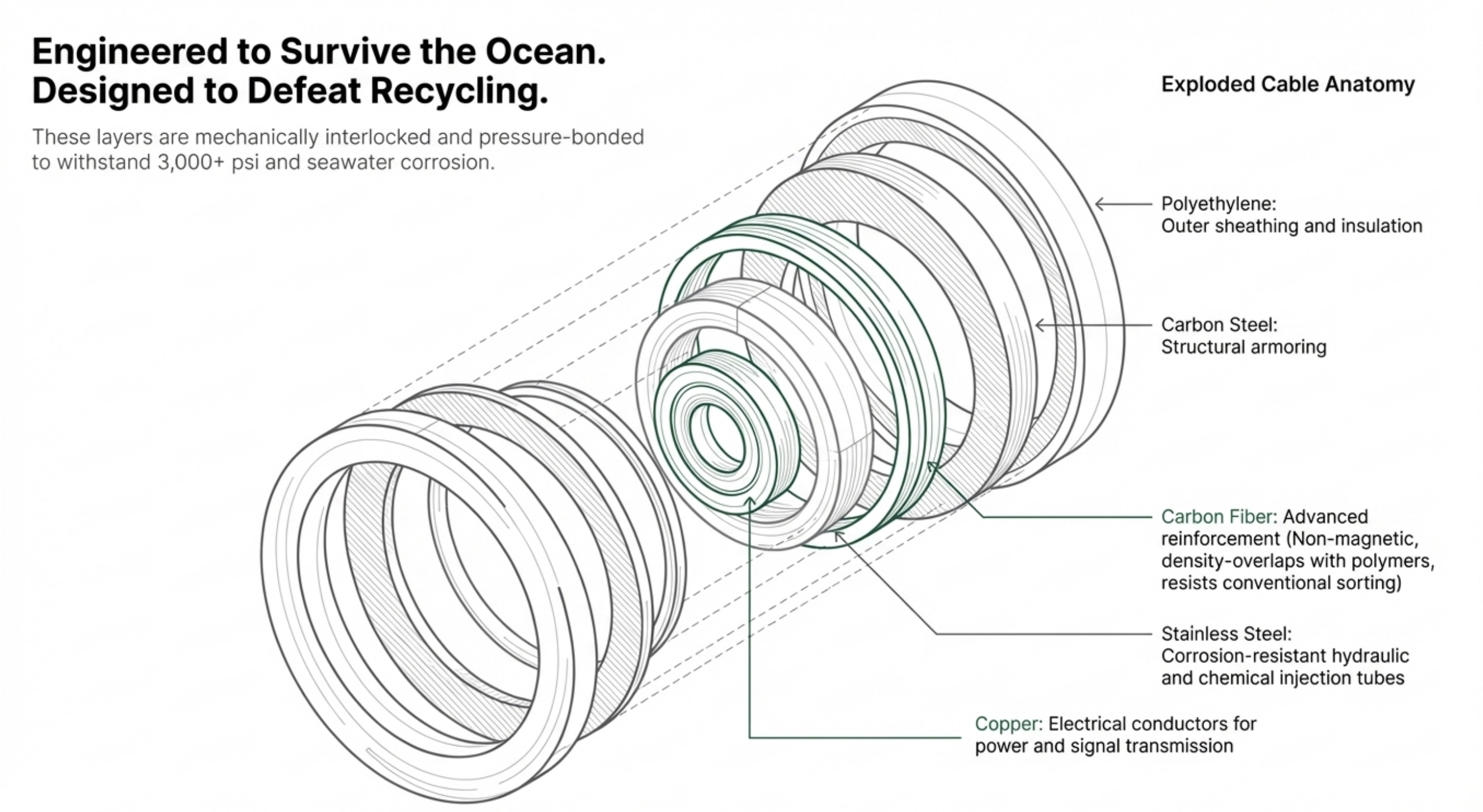
Not Ordinary Cable
A subsea umbilical integrates multiple material systems in mechanically interlocked, pressure-bonded layers engineered to withstand 3,000+ psi, seawater corrosion, and decades of cyclic fatigue. This cable contained five recoverable streams:
Carbon steel — structural armoring
Stainless steel — corrosion-resistant hydraulic and chemical injection tubes
Copper — electrical conductors for power and signal transmission
Polyethylene — outer sheathing and insulation
Carbon fiber — advanced reinforcement material
The carbon fiber is notable. It signals an advanced composite-armor design and compounds the separation challenge — carbon fiber is non-magnetic, overlaps in density with several polymers, and resists conventional sorting.
The Separation Problem
Every material system is bonded to its neighbors through mechanical interlocking, adhesive contact, and compressive nesting. These are intentional design features. They keep the cable intact at the bottom of the ocean.
They also make recycling exceptionally difficult.
At room temperature, polyethylene smears onto metal surfaces during shredding rather than fracturing cleanly. Steel armor wires degrade shredder blades at scale. Copper and steel in alternating layers produce contaminated mixed-metal particles. Carbon fiber defeats both magnetic and density-based separation.
The challenge isn’t any single technology. It’s the engineering judgment to sequence multiple technologies correctly for a specific cable design, at a specific volume, while maintaining commodity-grade purity across every output.
Process 500 tons incorrectly and you produce 500 tons of contaminated material.
What Shapiro Did
Shapiro managed the project from collection through final commodity sale across three phases.
Phase 1: Secure collection and chain-of-custody
Specialized logistics for the full five-mile coil. Full chain-of-custody documentation from pickup through final sale — supporting regulatory compliance and auditable ESG reporting.
Phase 2: Secure destruction and material liberation
Industrial-scale shredding, cutting, and separation technologies rendered the umbilical permanently unusable while preparing material for downstream recovery. Destruction and liberation were a single integrated stage.
Phase 3: Multi-stage separation and recovery
Advanced multi-stage processing separated and recovered every major component to commodity grade. All five material streams entered secondary markets through Shapiro’s global commodity network.
The manufacturer received substantial revenue credits — transforming a production loss into a partial financial offset.
Results
1,000,000+ pounds processed. Five material streams recovered.
The manufacturer received meaningful financial recovery through commodity sales of reclaimed metals, polymers, and composites.
Turn a sustainability challenge into a revenue opportunity while lowering your carbon footprint.
Start with a Shapiro expert.
Why the Economics Favor Recovery
For metal-rich industrial scrap, the assumption that landfill is cheaper is structurally wrong. Copper alone holds commodity value that can exceed landfill costs by an order of magnitude.
Recycling cost minus recovered revenue versus landfill cost plus forfeited revenue.
When framed correctly, the economics aren’t marginal. They’re decisive.
Side-by-Side
Based on published industry benchmarks for large-scale mixed-metal cable projects.
Dimension | Landfill | Full recovery |
Cost / revenue | Net expense | Net revenue returned |
Material recovered | None | All major components |
CO₂ impact | Net positive emissions | 60–85% energy reduction vs. virgin |
Landfill volume | Full tonnage consumed | Maximized recovery |
Long-term liability | Monitoring & leaching risk | Zero residual liability |
Sources: EREF 2024 tipping fee data, International Copper Association, WorldSteel Association, EPA WARM v16.
Estimate the Impact for Your Cable
The interactive calculator applies published commodity pricing, EPA carbon avoidance factors, and industry-standard composition ratios. Select your cable type and weight — the math updates in real time.
Uses public benchmark data. Does not reflect project-specific figures.
Subsea cable recycling impact calculator
Sources and Methodology
Project facts — Cable length, weight, diversion rate, five material streams, secure destruction, chain-of-custody, and revenue return confirmed by project participants. No project-specific financial figures or composition percentages are disclosed.
Industry context — Decommissioning projections: World Economic Forum (2024). Recycling rates: operator sustainability reports (ExxonMobil, Equinor, Shell, Petrobras, TotalEnergies). Rates below 65%: Scottish research via Business Insider. UK data: OEUK Decommissioning Insight Report 2024.
Regulatory — BSEE 30 CFR 250 Subpart Q; OSPAR Decision 98/3; EU Environmental Crime Directive 2024; GAO-24-106229 (2023). Verified current March 2026.
Calculator — COMEX, Steel Market Update, Fastmarkets (March 2026). CO₂: CarbonChain, WorldSteel, EPA WARM v16, Springer LCA 2025. Composition: ISO 13628-5. Estimates only.
About Shapiro
Industrial recycling since 1904. 11 North American facilities. ISO 9001:2015 certified. Three divisions: industrial recycling, Circular by Shapiro (sustainability dashboards, consulting, Scope 3 calculations), and Master Alloys (custom alloy programs).