Market Insights

The National Debt: Everyone’s Concern and Nobody’s Problem | September 2026

Dark Green Hexigon Icon Market Insights
  The National Debt: Everyone’s Concern and Nobody’s Problem | September 2026

CONSUMER BUYING PRICES

I will be traveling in October. Okay, vacationing. At 79, as long as my wife and I are relatively healthy, we are going to keep traveling while we can. I mentioned this to my friend Eric Harris, and he phrased it perfectly: “As long as I am moving, I'm moving.”

So, there will be no Market Insights in October. I will be back in November, after the election. As for who I will vote for, my thoughts can probably best be summed up with one question: Who would Dolly Parton vote for?

Dolly spent much of her life giving back. In 1995, inspired by her father's inability to read and write, she founded Dolly Parton's Imagination Library, which provides free books to children from birth to age five. In 2025, the program surpassed 300 million books gifted worldwide. She turned something deeply personal into something that will improve lives for generations.

Maybe there is a lesson in that. We spend a lot of time arguing about who is right, who is wrong, and who is to blame. What matters more is what we actually do about the problems in front of us.

And we have some big ones.
 
B6b58161 68ad 1546 572d 09f49910ae0b
 

The national debt has now passed $40 trillion. Everyone seems concerned about it, but no one seems particularly interested in taking responsibility for it. Democrats blame Republicans. Republicans blame Democrats. Meanwhile, the debt keeps growing.

So how did we get here and, more importantly, what are we going to do about it? There are no easy answers, but ignoring the problem certainly isn’t one of them.

What party is responsible for increasing the national debt?

The short answer is both.

Democrats have traditionally been more willing to increase domestic spending, while Republicans have campaigned on cutting government spending and balancing the budget, or at least they used to. Yet, with the exception of four years of budget surpluses under Bill Clinton, the federal government has run annual deficits every year since 1970.

Ronald Reagan ran for office in 1980 promising to balance the budget deficitof $70 BILLION by attacking waste, fraud and abuse in the federal government. During his eight years in office, annual deficits averaged roughly $180 billion. George H.W. Bush followed, famously promising, “Read my lips: no new taxes.” Deficits continued to grow.

Then came Bill Clinton. After deficits during his first years in office, the federal government recorded four consecutive budget surpluses from 1998 through 2001, the last time that has happened.

Since 2002, we have been back in the red.

Deficits grew dramatically during the Great Recession, exceeding $1 trillion annually from 2009 through 2012 before declining again. Then came COVID-19. Emergency spending and tax relief pushed the deficit above $3 trillion in 2020 and close to $3 trillion in 2021.

Today, the national debt has passed $40 trillion.

So where does all that money go? Five categories account for a large majority of federal spending:

Social Security: 22%
Medicare: 15%
Net interest on the national debt: 14%
Medicaid and other health programs: 13%
Defense: 13%

That brings us to the hard part: What can the government actually do about it?

The answers sound simple. Cut spending. Raise taxes. Grow the economy and generate more tax revenue.

Actually doing those things is anything but simple.

The federal deficit was $1.8 trillion in 2025, and the Congressional Budget Office now estimates it will reach about $2.1 trillion in 2026. CBO also projects roughly $1 trillion in net interest costs this year, with those costs continuing to rise substantially over the next decade. By 2036, CBO projects annual net interest costs could exceed $2 trillion.

That means an increasingly large amount of our money will be spent simply paying for money we have already borrowed.

Americans appear to understand that there is a problem. An August survey by the nonpartisan Peter G. Peterson Foundation found that 82% of registered voters believe the national debt should be among the top three priorities for the president and Congress, while 85% want elected leaders to spend more time addressing it. Those concerns cross party lines.

The elections are coming up, but I have not heard many politicians campaigning on what fixing the debt would actually require.

No one is standing at a podium saying, “Elect me. I will cut spending. Oh, by the way, that could mean making difficult decisions about Social Security, Medicare, health programs and defense. And we will definitely need to raise taxes, too.”

Right... Problem solved.

Few economists believe a debt crisis is imminent, but the risks increase as the debt and the cost of servicing it continue to grow. At some point, difficult decisions will have to be made. As the saying goes, eventually we have to pay the piper.

My parents were born around 1915 and lived through the Great Depression. From an early age, I was taught to save money and put something away for a rainy day.

The metals business is cyclical. When Shapiro has good years, we save. When we have bad years, those savings help carry us through.

The federal government does not have that luxury anymore. We have spent through the good years and the bad ones, and the rainy-day fund is already borrowed money.

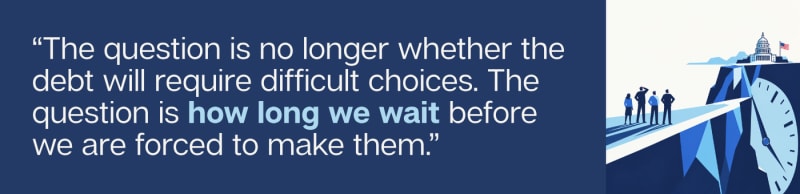
The question is no longer whether the debt will require difficult choices. The question is how long we wait before we are forced to make them.

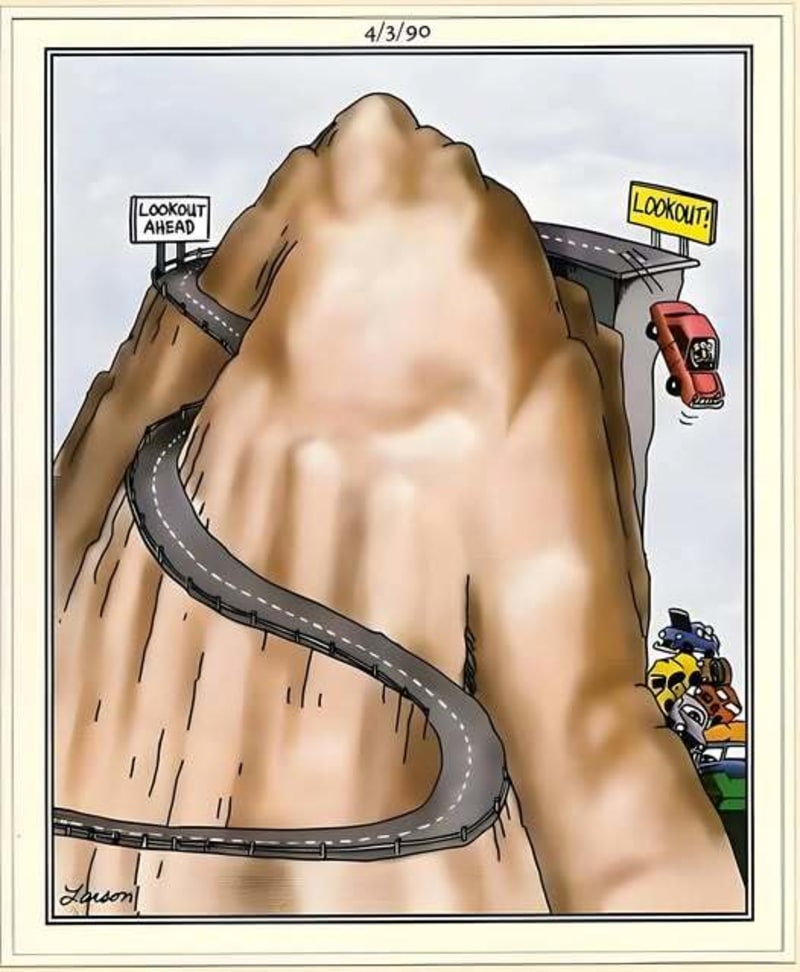
Brings me back to this Gary Lawson cartoon, “Lookout Ahead.”
 
9f41fb17 8f18 76e1 3d62 Bfb0a17f99e0
 

Tariffs. Canada. Aluminum.

The trade war with Canada continues to escalate, and I still struggle to understand what we hope to accomplish.

In August, The Wall Street Journal editorial board revisited what it had previously called “the dumbest trade war in history,” arguing that “escalating tariffs against Canada makes little economic or political sense.”

I tend to agree.

Canada and the U.S. have been trading partners forever, and our supply chains are deeply intertwined. The auto industry is a perfect example. Vehicles and parts cross the border throughout the manufacturing process, so when you add tariffs, both countries pay the price. This trade war is a lose/lose deal.

I am not against every tariff. There is a time and place for them. Tariffs against China make sense to me. China's strategy has been to build enormous manufacturing capacity and sell goods around the world at prices that are difficult for other manufacturers to compete with. Over time, that has helped China become dominant in several strategically important industries.

But Canada is not China.

When there are trade disagreements with an ally and longtime trading partner, I believe the better answer is to negotiate and get to a resolution. Teddy Roosevelt famously said, “Speak softly and carry a big stick.” There is something to be said for the speaking-softly part.

For Shapiro and our customers, my biggest concern is the tariffs on aluminum, steel and copper.

These metal tariffs were imposed under Section 232 of the Trade Expansion Act, which allows tariffs when imports are determined to threaten national security. Unlike the tariffs imposed under the International Emergency Economic Powers Act, Section 232 remains in effect.

Really? Aluminum, steel and copper imports threaten national security? I understand the need to protect U.S. manufacturing and critical supply chains. I just question whether making the raw materials our manufacturers need more expensive is the best way to do it.

And somebody has to pay for it.

Automakers have already reported billions of dollars in tariff-related expenses. Those costs don't simply disappear. They are eventually absorbed by manufacturers and suppliers or passed along to consumers.

Aluminum is where this gets especially interesting.

The U.S. relies heavily on imported primary aluminum, and Canada has historically been our largest foreign supplier. There is a reason for that. Producing aluminum requires an enormous amount of electricity, and Canada's abundant hydroelectric power gives its smelters a significant advantage.

As they say, aluminum is liquid electricity.

But we have another source of aluminum much closer to home.

Recycled aluminum requires about 95% less energy than producing primary aluminum. The Aluminum Association estimates that the U.S. could recover another 1 to 2 million metric tons of usable aluminum scrap that is currently landfilled. Recovering that material could fill a significant portion of our current aluminum supply gap.

Now, recycling another 1 to 2 million tons of aluminum is easier said than done. There are many different aluminum alloys with different uses. We would need more collection, sorting, melting and rolling capacity. That means investment, infrastructure and time.

And we would still need primary aluminum.

The Aluminum Association itself has identified reliable access to Canadian primary aluminum as an important bridge while the U.S. builds more domestic production and recycling capacity.

To me, that makes a lot more sense.

Recycle more of the aluminum we already have. Invest in U.S. recycling and manufacturing capacity. Create jobs here. And continue buying the primary aluminum we still need from one of our closest trading partners.

We can argue about tariffs all day long. But if the goal is to make American manufacturing stronger and less dependent on foreign supply, maybe we should start by making better use of the metal we are already throwing away.

INFLATION

Moving in the Wrong Direction

Inflation is moving higher again, and with employment still relatively strong, the Fed has a decision to make.

The Fed meets this week, with its decision coming Wednesday.

We'll see.

  • The Consumer Price Index (CPI) rose 0.4% in August, up from just 0.1% in July. On an annual basis, inflation remained at 3.4%. Core inflation, which excludes food and energy, rose 0.3% for the month and 2.4% over the past year.

  • The Fed's preferred inflation measure, the Personal Consumption Expenditures (PCE) Price Index, rose 0.2% in July after declining 0.1% in June. On an annual basis, PCE inflation remained at 3.7%. Core PCE also rose 0.2% for the month and was up 3.3% from a year ago.

  • Producer prices are also moving higher. The Producer Price Index (PPI) rose 0.4% in August and was up 5.4% over the past year. Prices for goods jumped 1.1% during the month, while services rose just 0.1%.

None of these numbers by themselves are alarming, but they are certainly not moving in the direction the Fed would like.

Inflation is still well above the Fed's 2% target, producer prices are rising, and the economy continues to show resilience.

I would put my money on a quarter-point rate hike Wednesday.

MANUFACTURING

It’s the AI Economy

The rest of the economy ain’t so bad either.

Manufacturing continues to expand, even if August cooled slightly.

The ISM Manufacturing PMI fell to 54.6 in August from 55.6 in July, but this marks the eighth consecutive month of expansion. Fifteen of the eighteen major manufacturing industries reported growth, and all of the major activity indexes remain in expansion territory.

There is some especially encouraging news underneath the headline number. New orders, which had been weak going back to 2023, remain in expansion at 53.7. Order backlogs are at 51.8 and have grown throughout 2026 after more than three years of contraction. Even better, the employment index remained in expansion for the second month in a row at 51.2 after nearly three years of contraction.

AI continues to be the economic beast.

Core industrial production rose 0.3% in July after declining 0.1% in June. High-tech equipment production jumped 1.9% for the month and is up 11.9% from a year ago. Over the last three months, it has grown at a 29% annualized rate.

That is insane.

But it is not just AI.

Manufacturing of business equipment rose 0.8% in July and is up 6.6% over the past year, far ahead of the 1.1% increase in overall industrial production. ITR is forecasting the twelve-month moving average to generally rise through at least 2028, with more of a plateau in 2027.

Core capital goods orders rose another 0.4% in July and are up 11.0% from a year ago. Primary metals rose 1.5%, industrial machinery 1.2% and fabricated metal products 0.4%. Computers and electronic products slipped 1.1% for the month but are still up an impressive 14.8% over the past year.

Shipments of core non-defense capital goods rose 1.4% in July. If that pace holds, third-quarter shipments would be running at a 12.6% annualized rate compared with the second quarter.

Yes, AI is driving a lot of this. But the rest of the economy ain’t so bad either.

A few other numbers worth watching:

  • Consumer income rose 0.4% in July, while spending increased 0.2%.

  • Small business optimism dipped to 98.7 in August from 99.8 in July, but remains above its 52-year historical average of 98.0.

  • Nonfarm payrolls increased by 162,000 jobs, while unemployment remained at 4.1%.

  • Construction spending declined 0.5% in July.

  • Car and light truck sales increased 2.6% in August and are up 4.3% from a year ago, with an annual rate of 16.3 million vehicles.

  • Civilian aircraft equipment production declined 4% in August, although ITR continues to forecast year-over-year production growth through at least 2028.

Finally, the Shapiro Nonferrous Scrap Activity Index, which tracks purchases from the same industrial accounts across our nine locations, showed virtually no change again in August based on our twelve-month trailing average.

The monthly numbers will always bounce around. Some will be up. Some will be down. But when you step back from the month-to-month noise, the bigger picture for manufacturing still looks pretty good.

AI may be the economic beast, but it isn’t the whole economy.

CHINA

How Long Can China Keep Its Manufacturing Stranglehold?

China continues to dominate global manufacturing, but I keep wondering how long this strategy can last.

At the recent G20 finance meeting, the focus was on economic growth, investment, global debt, and trade imbalances. Nineteen members agreed on language addressing several major issues. China was the only one that objected to provisions dealing with:

  • Efficient supply chains for critical minerals

  • The risks of relying too heavily on exports for growth

  • Faster sovereign debt restructuring

U.S. Treasury Secretary Scott Bessent did not mince words

“We believe that nonmarket-based economies pushing out a never-ending stream of cheap exports is not sustainable. It is clear that the country with the world's largest and unsustainable current account surplus, People's Republic of China, was the dissenter.”

And you can see why.

China's trade surplus is on track to approach or surpass last year's record of roughly $1.2 trillion. The value of China's semiconductor exports jumped about 130% in August, fueled by enormous demand for AI and data centers. Overall, exports to the U.S. rose 34.3% despite high tariff rates.

That is an astounding amount of manufacturing output flowing into the rest of the world.

Exports are the holy grail for China.

China has built a system around producing more than its domestic economy can absorb and selling the excess around the world. That has helped China gain enormous influence over global trade and supply chains without firing a bullet.

But there is a problem.

China keeps talking about boosting domestic consumption, but consumer demand remains weak. The property market is still struggling, and Chinese leaders have been reluctant to rely heavily on direct support for households. Xi Jinping has even warned against what he calls “welfarism.”

Meanwhile, the manufacturing machine keeps running.

China's official Manufacturing PMI improved slightly to 49.8 in August but remained below 50 and in contraction. Non-manufacturing activity was even weaker at 49.0, with continued weakness in construction and services.

So, China has an interesting problem.

Its manufacturing and export engine is incredibly powerful, but its domestic economy is not keeping pace. China continues to rely heavily on the rest of the world to buy what it produces.

How long can that continue?

China can keep investing. It can keep producing. It can keep exporting. But eventually, the rest of the world has to be willing and able to keep buying.

That may be the biggest challenge to China's manufacturing stranglehold. 

METALS

The Big Elephant in the Room Continues to be Aluminum Tariffs

Near the end of August, there was a hint that tariffs on Canadian aluminum could drop from 50% to 25%. The Midwest Premium dropped sharply on the news.

The next day, it was back up.

Welcome to the aluminum market.

Global supply remains a mixed bag. Production in the Middle East continues to recover from earlier disruptions, although getting smelters fully back online takes time. Indonesia is also adding significant new production capacity, and China has increased supply.

At the same time, worldwide aluminum stock remains extremely low. International Aluminium Institute data shows overall aluminum production still lagging last year.

That leaves analysts all over the place.

Most analysts see the market moving toward balance or even a slight oversupply as more production comes online. Harbor is still forecasting a large inventory deficit and $4,000 LME aluminum in the first half of 2027.

Stay tuned. The forecasts will undoubtedly change. They always do.

Closer to home, prime aluminum prices finally recovered some ground in August.

From May through July, PMTA dropped $0.375 per pound, from $2.827 to $2.512. August PMTA increased $0.08 to $2.593.

Prime scrap has been even stronger. Prices have risen despite the decline in PMTA and are now above May levels because prime scrap remains tight. September prime scrap prices are up another $0.04 to $0.06 per pound.

Elsewhere in metals:

  • Secondary aluminum prices are down slightly.

  • Copper and nickel are about the same.

  • Stainless steel increased about $0.03 per pound.

  • Steel prices are virtually unchanged.

Tariffs, tight inventories, recovering production and new capacity are all pulling aluminum in different directions.

In other words, just another month in the metals business.

CLOSING

Taking Care of the Here and Now

We will always be faced with VUCA: volatility, uncertainty, complexity, and ambiguity.

There are the challenges of climate change, with floods, fires, and tornadoes. People continue to die in wars around the world. We cannot control everything that happens around us. We can only control how we react.

For me, that is always easier said than done.

Earlier I mentioned Dolly Parton. I recently heard her say something that stuck with me:

“If you do the right thing in the here and now, the future has a way of taking care of itself.” She followed it with, “Well, at least that's what my mama taught me.”

Maybe Mama Parton had the right idea.

Market Insights focuses on economics, and there is certainly no shortage of VUCA here. Budget deficits will keep growing until we decide to do something about them or a crisis forces us to. Trade wars will eventually be resolved. Other wars will end or pause. Elections will always be ugly.

And I am clueless on AI.

We cannot predict what the economy will look like ten years from now. We certainly cannot predict what AI will look like ten years from now. But we can do the right thing in the here and now.

Maybe that means dealing with our debt before a crisis forces us to. Maybe it means investing in American manufacturing and recycling more of the materials we already have. Maybe it simply means leaving things a little better than we found them.

As many crises as we have faced in our short 250-year history, we have always found a way forward. That is worth remembering and believing in.

The future will get here soon enough. Let's take care of the here and now.

The Jewish New Year

I am now celebrating the Jewish New Year, 5787, beginning with Rosh Hashanah. Rosh Hashanah begins the Ten Days of Repentance, which culminate in Yom Kippur, the Day of Atonement.

These holy days are very different from the New Year's celebration at the end of the calendar year. For me, this is a time to reflect on what I have done during the past year and take responsibility for my actions toward other people and G-d.

We pray for forgiveness from G-d for our sins. Some may seem small: being selfish, judgmental, unkind or ungenerous. Others are much more serious.

But there is an important distinction. We can ask G-d to forgive the sins we have committed against G-d. For wrongs we have committed against family, friends and other people in our lives, we must go to those people and ask them for forgiveness.

That is not so easy.

The Ten Days of Repentance conclude with Yom Kippur, the Day of Atonement. It is a solemn day of fasting, prayer and reflection. We ask G-d once again for forgiveness and confront something we probably don't think about often enough: the uncertainty and fragility of our lives.

One of the traditional prayers of these holy days asks who shall live and who shall die in the coming year and teaches that repentance, prayer and charitable acts can affect the decree. It is powerful and humbling.

Of course, not all Jews practice or believe exactly the same things, just as people of other faiths do not interpret their traditions in exactly the same way either. This is simply my interpretation of what these holy days mean to me.

I believe I should always try to be a good person. Treat people the way I want to be treated. Express my gratitude. Take responsibility when I have done something wrong and, as difficult as it sometimes is, ask for forgiveness.

I wish you all Shana Tovah, a Happy New Year and, most importantly, a healthy one.

“There is nothing wrong with America that cannot be cured by what is right with America.”
— Bill Clinton